Schedule
The scheduling in Control Center has four modes, dbWatch cron schedule, traditional cron schedule, interval schedule and manual schedule.
dbWatch Cron schedule
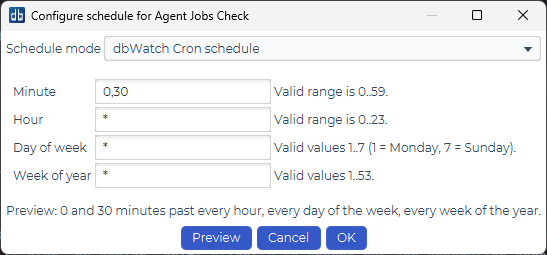
The dbWatch cron schedule is loosely based on the crontab format used on Unix systems. We have 4 fields that can be set, “Minute”, “Hour”, “Day of week”, and “Week of year”.
| Field | Description |
|---|---|
| Minute | A number between 0 and 59, indicating the minute past the hour this will be scheduled. It can also have a list of numbers with commas between them to run at several specific minute values, or a * to indicate every minute. |
| Hour | A a number between 0 and 23, indicating the hour this will be scheduled. It can also have a list of numbers with commas between them to run at several specific hour values, or a * to indicate every hour. |
| Day of week | A number between 1 and 7, indicating the day of the week. Monday is 1, Tuesday is 2, Wednesday is 3, Thursday is 4, Friday is 5, Saturday is 6 and Sunday is 7. It can also have a list of numbers with commas between them to run at several specific day values, or a * to indicate every day of the week. |
| Week of year | A number between 1 and 53, indicating the week of the year. It can also have a list of numbers with commas between them to run at several specific “week of year” values, or a * to indicate every “week of the year”. |
Clicking on the preview button evaluates values and writes them out in a more human-readable form.
Traditional cron schedule
The traditional cron schedule uses the standard Unix crontab format. It defines a repeating schedule with 5 fields: “Minute”, “Hour”, “Day of month”, “Month”, and “Day of week”.
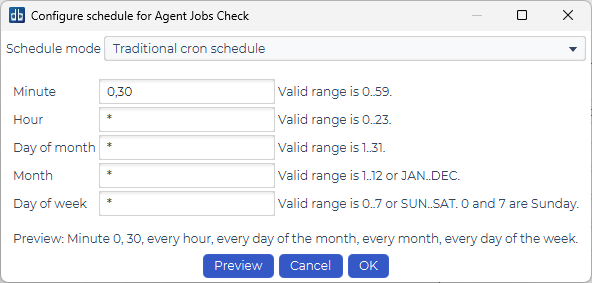
| Field | Description |
|---|---|
| Minute | A number between 0 and 59, indicating the minute past the hour when the job will run. It can also have a list of numbers separated by commas to run at several specific minute values, a range such as 10-20, or a * to indicate every minute. |
| Hour | A number between 0 and 23, indicating the hour of the day when the job will run. It can also have a list of numbers separated by commas, a range such as 8-17, or a * to indicate every hour. |
| Day of month | A number between 1 and 31, indicating the day of the month when the job will run. It can also have a list of numbers separated by commas, a range, or a * to indicate every day of the month. |
| Month | A number between 1 and 12, indicating the month when the job will run. It can also have a list of numbers separated by commas, a range, or a * to indicate every month. |
| Day of week | A number between 0 and 7, indicating the day of the week when the job will run. Depending on the cron implementation, 0 and 7 both represent Sunday. It can also have a list of numbers separated by commas, a range, or a * to indicate every day of the week. |
The job runs when the current time matches all specified fields. This makes traditional cron useful for schedules such as “every day at 02:30″, “every Monday at 08:00″, or “at 15 minutes past every hour”.
Interval schedule
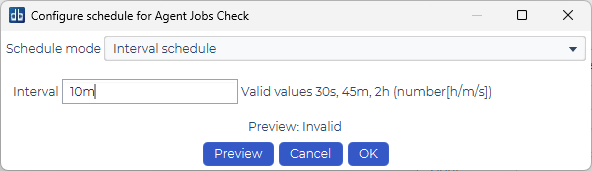
The interval schedule can schedule a job at repeating, but not exact times. Values are a number with a time denominator, such as 30m (every 30 minutes) or 3h (every 3 hours).
Values can range from 1 to the max value for int, but scheduling more frequently than around 15s will not be accurate due to limitations in the scheduling timing code.
The interval scheduling will also, by design, drift slightly to sparse out job scheduling across the database instance farm.
Manual schedule
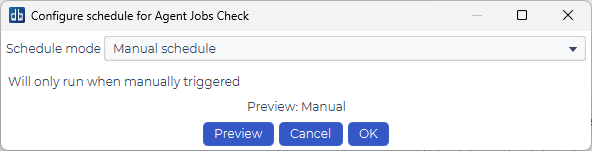
Manual schedule means the job will not run unless explicitly triggered by a user, by right clicking it and selecting “Run now”.